Category: Home Organisation

Practical room-by-room systems for a calmer, easier-to-manage home.

  • Toy Storage in a Small Living Room: A Practical Family System

    Toy Storage in a Small Living Room: A Practical Family System

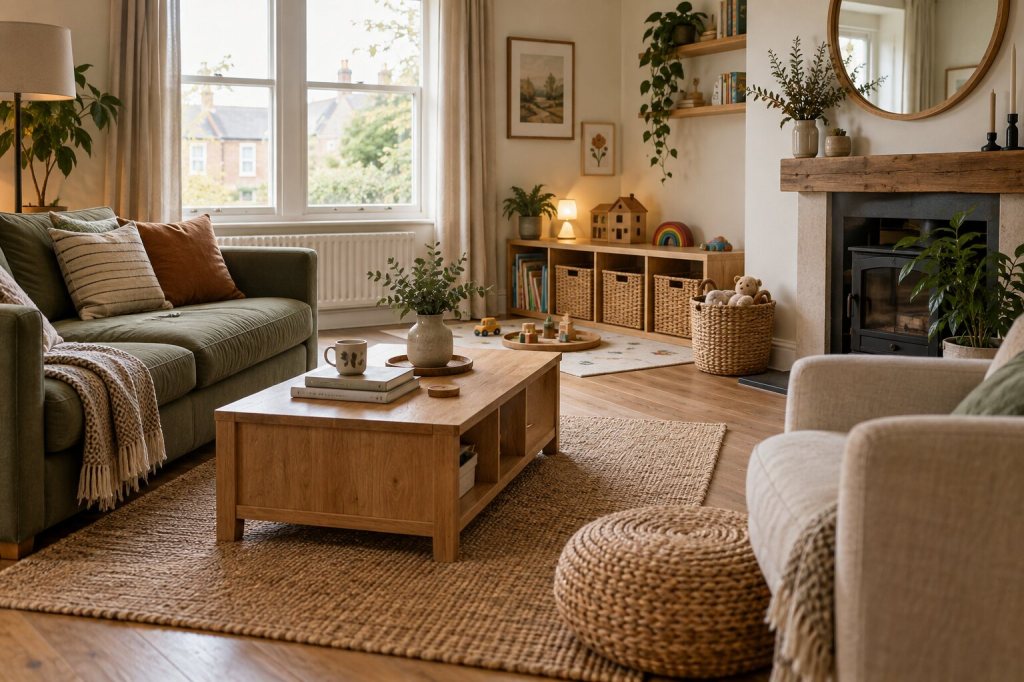
    A shared living room needs to work for play and for adult life. The goal is not to make toys invisible all day. It is to give children meaningful access while making the room straightforward to reset.

    Reduce before organising

    Remove broken toys, incomplete sets and items that are no longer age-appropriate. Keep favourites and open-ended toys easy to reach. Store sentimental items separately from everyday playthings.

    Use broad categories

    • Building toys
    • Vehicles
    • Pretend play
    • Puzzles and games
    • Creative supplies
    • Soft toys

    Very specific sorting creates too many decisions during tidy-up. Broad groups make it possible for a child to help and reduce the number of containers needed.

    Choose low, stable storage

    Low units allow children to see and return toys independently. Follow the furniture manufacturer’s instructions for wall fixing and loading. Avoid heavy objects on high shelves, unstable stacks and containers with lids that trap small fingers.

    Prefer fewer open choices

    Displaying every toy at once can make play and tidying harder. Keep a manageable selection available and rotate less-used items from secure storage. Rotation does not need a schedule; swap when interest drops.

    Use containers children can handle

    Lightweight baskets with open tops or easy handles reduce friction. A picture label can help younger children. Check that materials and dimensions are appropriate for the child’s age and that small components are stored safely.

    Protect the adult zone

    Choose one boundary, such as a cabinet, two shelves or a defined corner. When the allocated area is full, rotate or reduce rather than extending storage across the room.

    Create a simple reset

    Use a short cue before dinner or bedtime and tidy one category at a time. Adults can gather pieces while children return baskets. Five consistent minutes are more effective than an occasional, exhausting sort.

    Allow play to continue

    Not every construction must be dismantled immediately. A tray or small designated surface can hold one work in progress. This respects the play while keeping the floor and main surfaces usable.

    Toy storage must always suit the child’s age and follow product safety and anchoring instructions.


    Practical Nest UK publishes independent, practical guidance. Check measurements, materials and retailer terms before buying.
  • How to Organise a Linen Cupboard Without Perfect Folding

    How to Organise a Linen Cupboard Without Perfect Folding

    A useful linen cupboard makes it obvious where clean bedding and towels belong. It does not require hotel-style folds or rows of decorative labels. Consistent categories and reasonable quantities matter more.

    Take stock by household need

    Group fitted sheets, duvet covers, pillowcases, bath towels, hand towels and guest items. Remove worn-out pieces, unmatched items you will not use and sizes that no longer fit any bed.

    Set sensible quantities

    Many households manage well with two complete bedding sets per bed: one in use and one ready. Your needs may differ if laundry is less frequent, guests stay often or young children require spares. The point is to choose a number deliberately.

    Keep sets together

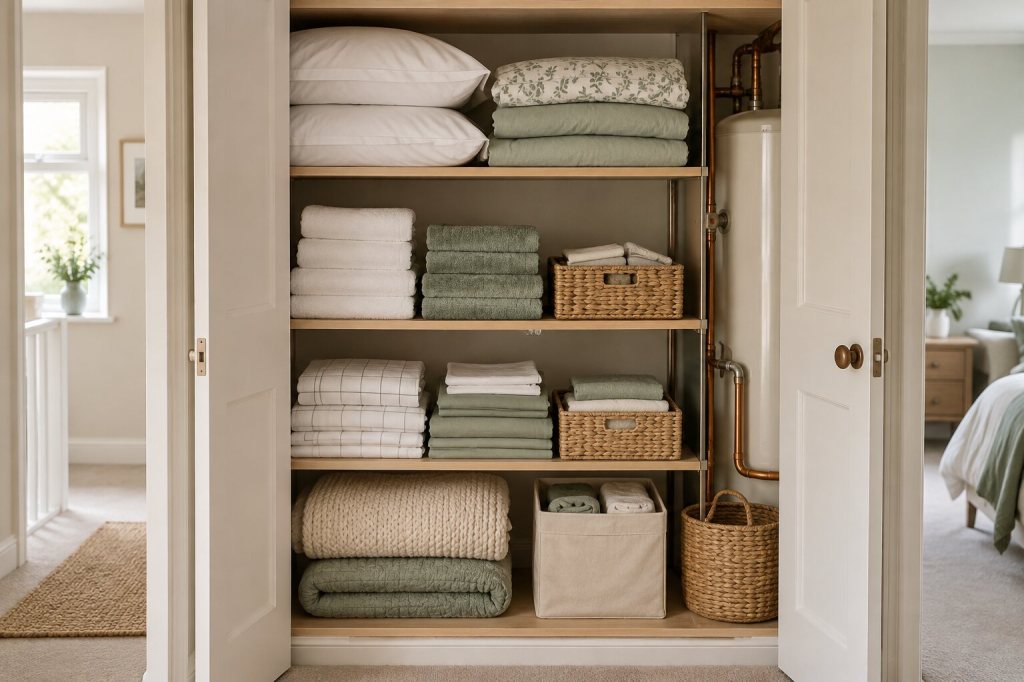
    Fold each bedding set and place it inside one matching pillowcase, or assign each bed a labelled shelf or basket. Either approach prevents the search for a matching component. Label by bed or mattress size rather than by colour alone.

    Use shelves by frequency

    • Everyday towels and current bedding at easy-reach height
    • Guest bedding above or below the main zone
    • Seasonal duvets on the highest shelf if safely accessible
    • Cleaning cloths in a separate, clearly marked container

    Avoid packing shelves tightly. You need enough room to remove one stack without collapsing the others.

    Manage deep shelves

    Deep cupboards often work better with handled baskets that can be pulled forward. Measure shelf depth, width and height before buying. A basket should fit the folded item, not force the item into an awkward shape.

    Store textiles properly

    Make sure linens are completely dry before storing them. Allow air circulation and follow care instructions for duvets and specialist materials. Avoid long-term storage in airtight plastic if the manufacturer advises breathable conditions.

    Use labels as directions

    Simple labels such as King Bedding, Single Bedding, Bath Towels and Guests help every household member put things away. If a label does not change behaviour, it is decoration rather than a system.

    Review at laundry time

    When clean linen no longer fits comfortably, do not create a new pile. Check whether damaged or surplus items can be repurposed, donated where accepted, or recycled through an appropriate textile scheme.


    Practical Nest UK publishes independent, practical guidance. Check measurements, materials and retailer terms before buying.
  • Hallway Storage Ideas for a Calm and Functional Entrance

    Hallway Storage Ideas for a Calm and Functional Entrance

    A hallway has to support departures, arrivals, deliveries and the things everyone carries. Because it is also the first view of the home, even a small amount of clutter can feel disproportionate. The answer is to give the most frequent items a clear landing place.

    Observe the traffic first

    For several days, notice what is dropped by the door and where people naturally reach. Storage placed against those habits is unlikely to last. The useful system belongs on the route between the door and the rest of the home.

    Define the essential zones

    • A limited number of everyday coats
    • Shoes currently in rotation
    • Keys, passes and small essentials
    • Incoming post or parcels
    • Bags used most days

    Move off-season coats, occasional shoes and archives elsewhere. The hallway should support the current week rather than store the entire household.

    Choose narrow storage

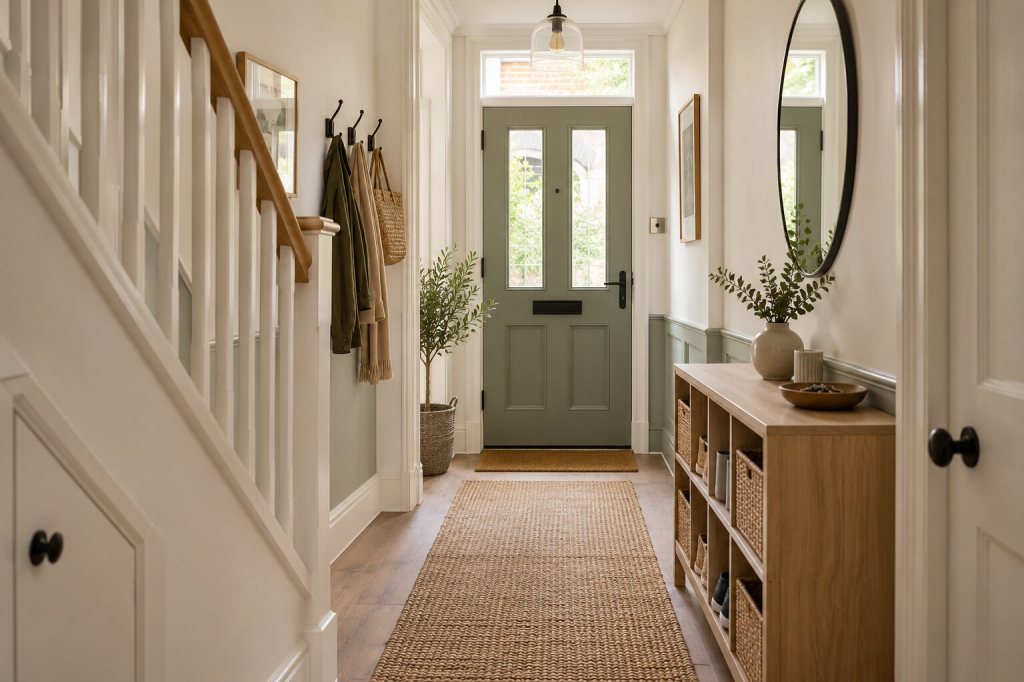
    In a tight entrance, shallow shoe cabinets and wall-mounted hooks can preserve walking space. Check door swing, radiator clearance and the width required to carry shopping through the hall. Furniture must be stable and fixed to the wall where the manufacturer requires it.

    Control shoes

    Give each person a clear limit such as one basket, shelf or row. Wet footwear needs ventilation and a surface that can be cleaned. A boot tray can protect the floor, but it should not become permanent storage for unused pairs.

    Create a landing spot

    Use a small bowl, tray or wall organiser for keys and passes. Keep the category narrow; a general-purpose basket soon fills with receipts, batteries and unrelated objects. Deal with post daily and recycle unwanted paper promptly.

    Make leaving easier

    A mirror, a reliable key location and a hook for the next day’s bag can remove repeated morning searches. If children use the space, place their hooks at a practical height and label them simply.

    Reset in two minutes

    At the end of the day, return shoes, hang coats and empty the landing tray. Once a week, remove items that have migrated into the hall. The best entrance system is one the household can reset faster than it can make tea.

    Keep the escape route and access to the front door clear at all times.


    Practical Nest UK publishes independent, practical guidance. Check measurements, materials and retailer terms before buying.
  • How to Organise Kitchen Cupboards for Everyday Cooking

    How to Organise Kitchen Cupboards for Everyday Cooking

    An organised kitchen is not one in which every packet sits in a matching jar. It is one in which the things you use together are easy to find, easy to reach and easy to put away.

    Empty one cupboard at a time

    A full kitchen emptied onto the floor creates fatigue. Choose one cupboard, remove everything, wipe the shelves and check dates. Group duplicates and move items that do not belong in that zone.

    Create activity zones

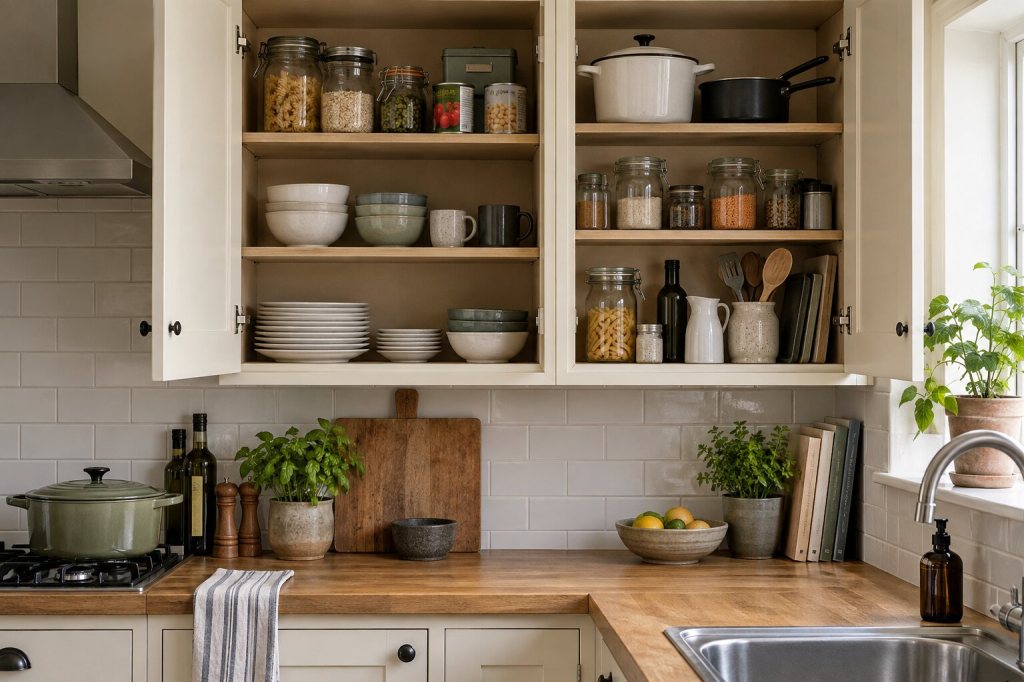
    • Tea and coffee near the kettle
    • Oils, spices and utensils near the hob
    • Baking ingredients and tools together
    • Breakfast foods in one accessible area
    • Lunch boxes, wraps and reusable bottles together

    Zones reduce repeated movement and make it easier for everyone in the household to return items correctly.

    Place by frequency and weight

    Keep everyday items between waist and eye level. Store heavy appliances on lower shelves so they can be lifted safely. Reserve the highest cupboards for light, occasional items rather than forgotten food.

    Use shelf depth wisely

    Deep cupboards hide small packets behind one another. A turntable can help with bottles and condiments; a shallow riser can make tins visible; a pull-out basket may help on a low shelf. Choose an organiser only after measuring the cupboard and the products it needs to hold.

    Keep food visible

    Arrange packets with labels facing forwards and place newer purchases behind older ones. A small “use first” basket can prevent open packets and near-date food from disappearing. Decant only when it genuinely improves visibility or keeps food fresh.

    Manage awkward items

    Store pan lids vertically in a divider if the cupboard has enough height. Nest pans only if you can remove the one you need without dismantling a tower. Baking trays and chopping boards often work better upright than stacked.

    Set capacity limits

    A category should fit comfortably in its space. If snacks overflow their basket or mugs fill two shelves, decide which items are favourites before borrowing room from another zone.

    Label for the household

    Labels are useful when several people use the kitchen or when a category is not obvious. Simple labels such as Breakfast, Baking and Lunch Boxes are more durable than overly specific ones.

    A five-minute weekly check

    Before shopping, scan the cupboards, bring older items forwards and add only genuine gaps to the list. This small routine prevents duplicates and keeps the system useful.


    Practical Nest UK publishes independent, practical guidance. Check measurements, materials and retailer terms before buying.
  • Small Bedroom Storage Ideas That Do Not Add Visual Clutter

    Small Bedroom Storage Ideas That Do Not Add Visual Clutter

    A small bedroom needs to store a surprising number of things while still feeling restful. The best solutions are rarely more containers. They are better use of height, concealed space and clear limits for each category.

    Start with the bed

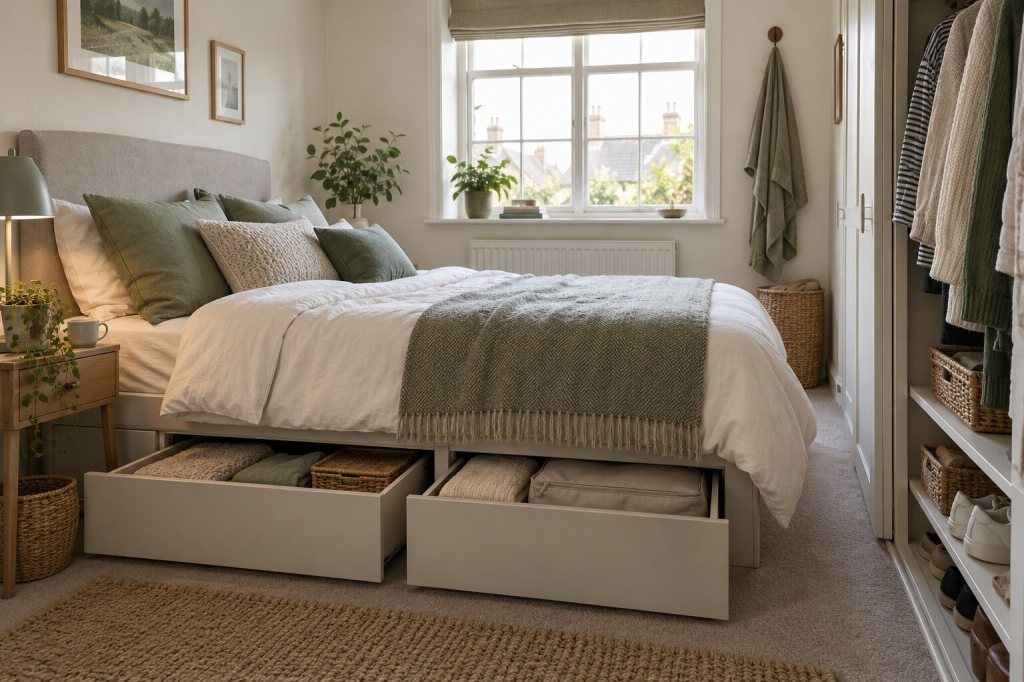
    Under-bed space can hold spare bedding, off-season clothing or occasional items. Measure the height, width and depth before buying boxes, and allow clearance for handles or wheels. Choose lidded storage if dust is a problem, but avoid filling it with things you never use.

    Make the wardrobe work harder

    • Use matching slim hangers to reduce wasted rail space
    • Add a second rail only for short garments if the layout allows
    • Place less-used items on the highest shelf in labelled boxes
    • Keep the floor clear or assign it one defined purpose
    • Store everyday clothes where they are easiest to reach

    A wardrobe is easier to maintain when each shelf has breathing room. If everything fits only when compressed, remove a category before adding organisers.

    Choose bedside storage with intent

    A bedside table with a drawer hides chargers, medication and small necessities. In very tight rooms, a narrow wall shelf can provide enough room for a lamp, phone and book without occupying much floor space.

    Use walls carefully

    Hooks behind a door can hold a dressing gown or tomorrow’s outfit. A shallow rail or a few well-positioned pegs may be more useful than a large freestanding unit. Keep wall storage visually quiet and avoid turning every vertical surface into display space.

    Control clothing in transition

    Worn-but-not-ready-to-wash clothes often become the chair pile. Give them one deliberate place: two hooks, a small basket or one section of a valet stand. The capacity limit is useful; when it is full, items must return to the wardrobe or laundry.

    Reduce visual noise

    Closed storage generally makes a small room feel calmer than many open baskets. Repeat one or two materials, keep labels discreet and leave some surfaces empty. The room should look like a bedroom, not a stockroom.

    Measure before buying

    • Internal drawer or shelf dimensions
    • Door and drawer opening clearance
    • Skirting-board depth
    • Available height beneath the bed
    • The largest item the organiser must hold

    Check whether a product’s listed dimensions are internal or external. A few centimetres can decide whether folded clothes or shoes actually fit.

    Maintain the system

    Keep a donation bag in the wardrobe and review clothing at the change of seasons. Return items to their assigned zone rather than finding another container. Small bedrooms stay functional when storage has firm boundaries.


    Practical Nest UK publishes independent, practical guidance. Check measurements, materials and retailer terms before buying.

  • How to Declutter Your Home Room by Room

    How to Declutter Your Home Room by Room

    Decluttering becomes overwhelming when the job is described as “sort out the house”. A more useful approach is to make a series of small, visible decisions. Work in one contained area, finish it, and only then move on.

    Begin with a definition of finished

    For each room, decide what better would look like. A hallway might need a clear floor and one place for keys. A bedroom might need calm bedside surfaces and clothes that fit inside the wardrobe. A specific outcome stops the project expanding endlessly.

    Use four destinations

    • Keep here: useful items that belong in this room
    • Move: useful items with a proper home elsewhere
    • Donate or sell: good items you no longer need
    • Recycle or dispose: damaged, expired or unusable items

    Use bags or boxes for the last three destinations. Remove them from the room at the end of the session so that sorting does not become a new form of clutter.

    Work in an order that builds momentum

    Start with obvious rubbish and items that clearly belong elsewhere. Continue with flat surfaces, then one drawer, shelf or cupboard at a time. Leave paperwork, sentimental belongings and mixed storage boxes until you have built confidence.

    Ask practical questions

    • Have I used this in the last year?
    • Would I buy it again today?
    • Do I own another item that performs the same job?
    • Is keeping it worth the space and maintenance it requires?
    • If I needed it later, would it be difficult or expensive to replace?

    The aim is not to own as little as possible. It is to make the available space support daily life.

    A sensible room-by-room order

    The kitchen and bathroom often offer quick wins because expired products, duplicate utensils and empty packaging are relatively easy decisions. Move next to the hallway and living room, where visual calm has an immediate effect. Tackle clothing after that, then paperwork and sentimental items.

    Do not organise before reducing

    Buying baskets too early can hide excess without solving it. First decide what stays, group similar items, measure the available space and observe how you naturally use the area. Storage should be the final step.

    Create a ten-minute reset

    When the room is finished, choose the smallest routine that will preserve it: clear the worktop after dinner, return shoes before bed, or reset the coffee table each evening. A system that needs constant motivation will not last.

    A successful decluttered home is not permanently perfect. It is easy to reset.


    Practical Nest UK publishes independent, practical guidance. Check measurements, materials and retailer terms before buying.