
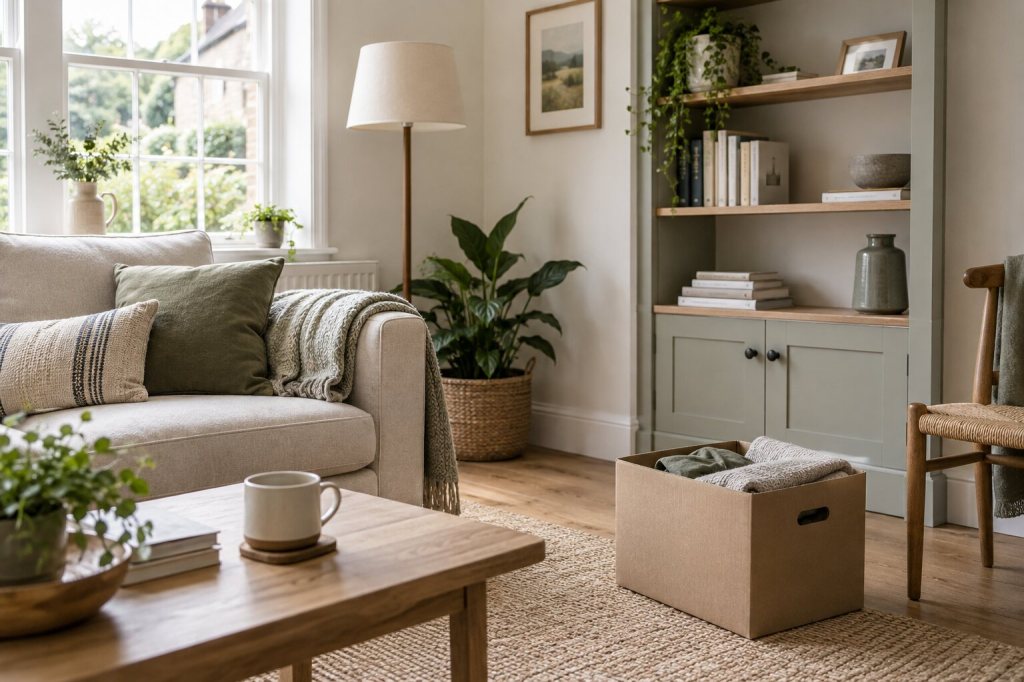
Decluttering becomes overwhelming when the job is described as “sort out the house”. A more useful approach is to make a series of small, visible decisions. Work in one contained area, finish it, and only then move on.
Begin with a definition of finished
For each room, decide what better would look like. A hallway might need a clear floor and one place for keys. A bedroom might need calm bedside surfaces and clothes that fit inside the wardrobe. A specific outcome stops the project expanding endlessly.
Use four destinations
- Keep here: useful items that belong in this room
- Move: useful items with a proper home elsewhere
- Donate or sell: good items you no longer need
- Recycle or dispose: damaged, expired or unusable items
Use bags or boxes for the last three destinations. Remove them from the room at the end of the session so that sorting does not become a new form of clutter.
Work in an order that builds momentum
Start with obvious rubbish and items that clearly belong elsewhere. Continue with flat surfaces, then one drawer, shelf or cupboard at a time. Leave paperwork, sentimental belongings and mixed storage boxes until you have built confidence.
Ask practical questions
- Have I used this in the last year?
- Would I buy it again today?
- Do I own another item that performs the same job?
- Is keeping it worth the space and maintenance it requires?
- If I needed it later, would it be difficult or expensive to replace?
The aim is not to own as little as possible. It is to make the available space support daily life.
A sensible room-by-room order
The kitchen and bathroom often offer quick wins because expired products, duplicate utensils and empty packaging are relatively easy decisions. Move next to the hallway and living room, where visual calm has an immediate effect. Tackle clothing after that, then paperwork and sentimental items.
Do not organise before reducing
Buying baskets too early can hide excess without solving it. First decide what stays, group similar items, measure the available space and observe how you naturally use the area. Storage should be the final step.
Create a ten-minute reset
When the room is finished, choose the smallest routine that will preserve it: clear the worktop after dinner, return shoes before bed, or reset the coffee table each evening. A system that needs constant motivation will not last.
A successful decluttered home is not permanently perfect. It is easy to reset.
Practical Nest UK publishes independent, practical guidance. Check measurements, materials and retailer terms before buying.
 Practical Nest UK